


In developing this prosthetic hand, I encountered several challenges, as I had no prior experience working with these specific materials. This documentation outlines the complete process involved in the design and fabrication of the piece.
Challenges :
•Creating a mold directly on a human model while ensuring complete safety and comfort throughout the process.
•Working with unfamiliar materials, including platinum-catalyzed silicones (Ecoflex™, Dragon Skin rubbers) and specialized painting techniques (Sil-Tone pigments)
•Preventing curing issues during the silicone setting process.
•Avoiding unwanted chemical bonding between the mold and poured liquid materials.
•Achieving a finish that is both realistic and deliberately nightmarish in appearance.
Making a mold on a model


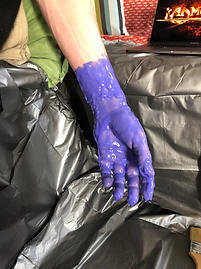


Products used : Body double silicon, Body double release cream.


Challenges :
•Capturing the maximum level of detail while maintaining the precise anatomical position of the hand throughout the entire process.
Solutions :
•First layer very liquid brushed into every detail and crease.
•Then several thicker layers to protect the mold and ensure the strength.
•Addition of plaster layers to reinforce the entire structure, made in two part so it encapsulate the mold and is easy to remove and reassemble.
Pouring of the silicone in the mold

Challenges :
•Ensuring that the release agent reach every details and fingertips to prevent bonding.
Solution :
•Making cuts along the side of the palm and at each fingertip, sealed again with silicone afterward.


Products used : Body double silicon mold, Easy release Mann 200.
Making of the prosthetics
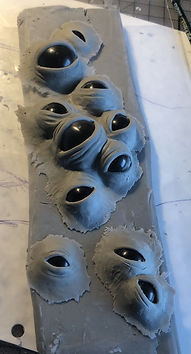


Challenges :
•Simplify the mold of the entire hand to avoid bubbles.
Solution :
•Sculpting eye sockets as independent prosthetic elements, designed to be applied to the artificial hand in a way that convincingly mimics human anatomy. The process begins with sculpting, followed by adding texture and blending the edges to facilitate application afterward.


Products used : Dragon skin mold silicon, plastilin.


Challenges :
•Preventing the silicone from adhering to the mold through unintended chemical bonding.
Solutions :
•Using Royal Jelly release agent, no cap encapsulator is needed.
Products used : Royal Jell-Y release agent, Ecoflex 00-30 silicone, Siltone pigments.
Bonding the eyes to the prosthetic


Products used : Sil-Poxy glue.
Making realistic eyes


Challenges :
•Create the most realistic look possible.
Solution :
•Carving the irises and pupils to add depth and detail.
•Using white resin to give the iris a "glassy" finish.
•Immersing the eye in transparent resin, back in its mold, to form the natural roundness of the eye.


Right eye more realistic after changing the resin's color.
Making teeth prostethics


Products used : Dragon skin mold silicon, Ecoflex 00-30, plastilin, Super-Cap IPA based, Derma-Tac adhesive.

Result applied as a normal prosthetic without paint.


Painting process


Challenges :
•Create the most realistic look possible.
Solution :
•Applying layers of Sil-Tone with a sponge and brush to achieve skin discoloration and a "wet and moldy" appearance of the skin and mushrooms.


Additional details include the radius of the forearm and the phalangeal bones of the finger. All sculpted by hand and cast in resin, then assembled using a metal rod and silicone.
